Forget opinion polls. We ranked the best US destinations by what actually matters: the numbers.
Americans will spend $1.37 trillion on travel in 2026. That figure, from the U.S. Travel Association, represents a record. And it tells only half the story. The other half lives in the data we rarely see combined: international visitor arrivals, accommodation search surges, hotel occupancy rates, and tourism economic impact. We cross-referenced all four metrics across 47 US destinations to produce this ranking. No reader votes. No editorial gut feelings. Just the numbers behind the most popular travel destinations in the country.
The picture that emerges is one of domestic dominance. Eighty-seven percent of that $1.37 trillion comes from travelers who never leave the country. Domestic accommodation searches are up 21% year over year, flight searches up 29%, and the conversation about American vacations on social media has doubled. The Great American City Break is no longer a marketing phrase. It is a measurable shift, from family vacations at beach resorts to outdoor adventures in national parks.
How we ranked: the 4 metrics behind this list
Every destination was evaluated against four data points that reveal where momentum sits right now.
- International visitor arrivals (2024 actuals from the National Travel and Tourism Office)
- Domestic search demand growth (year-over-year accommodation and flight searches from major travel platforms, Summer 2026)
- Hotel performance (occupancy rate and RevPAR trend from PwC and CoStar)
- Economic impact (tourism GDP contribution, visitor spending, and event-driven revenue)
We weighted arrivals and search growth equally, then used hotel performance and economic impact as tiebreakers. The result rewards both scale and acceleration. New York City dominates scale. Austin dominates acceleration. Both earn their place at the top for completely different reasons.
The 15 most popular US travel destinations right now
1. New York City
After reviewing arrivals data across every US gateway, no city comes close. New York welcomed 9.5 million overseas visitors in 2024, accounting for 27.1% of all international arrivals. Hotel occupancy sits at 87.9%, the highest of any major market, and the best hotels in Manhattan routinely sell out months ahead. Tourism revenue reached $88 billion. The 2026 FIFA World Cup, with MetLife Stadium hosting the final, is projected to add $3.3 billion in economic impact.
Beyond the data, NYC rewards every type of traveler. Free attractions like Central Park and the Brooklyn Bridge. Walking tours through Greenwich Village. The restaurants that make it the culinary capital of the country. The American Museum of Natural History for families. The High Line for outdoor exploration. Check the calendar for any time of year and you will find things to do that cost nothing and things that justify a splurge in equal measure.
2. Orlando
We tracked Orlando through five consecutive record-breaking years, and 2025 delivered the largest figure yet: 76.7 million total visitors, up 1.8%. Domestic visitation alone hit 70.3 million. Hotel tax revenue reached $384.6 million. Euromonitor ranked Orlando first globally in Tourism Performance. Then Epic Universe opened. Universal's newest theme park is projected to add 5 to 9 million annual visitors once fully ramped. Orlando is the most visited vacation destination in the United States by every available measure.
The resort hotels range from budget friendly to luxury. Beyond the theme parks, families find state parks nearby, wildlife tours, and day trips to Cocoa Beach or Clearwater. Planning a stay means choosing between attractions that keep every age group happy and a beach vacation just an hour away.
3. Miami
Miami pulled 4.4 million international visitors in 2024, second only to New York. As a World Cup host city, it is seeing event-demand early: short-term rental searches in host cities surged 80% year over year. The luxury hotel pipeline in Miami Beach and Brickell is the densest in the Southeast.
South Beach remains one of the most famous beaches in the country. Coral Gables and Coconut Grove deliver a resort town atmosphere. Food tours through Little Havana rank among the best things to do in Florida. Art lovers explore Wynwood Walls for free. Key Biscayne offers island vibes perfect for a family beach vacation, and outdoor activities on the water run year-round.
4. Austin
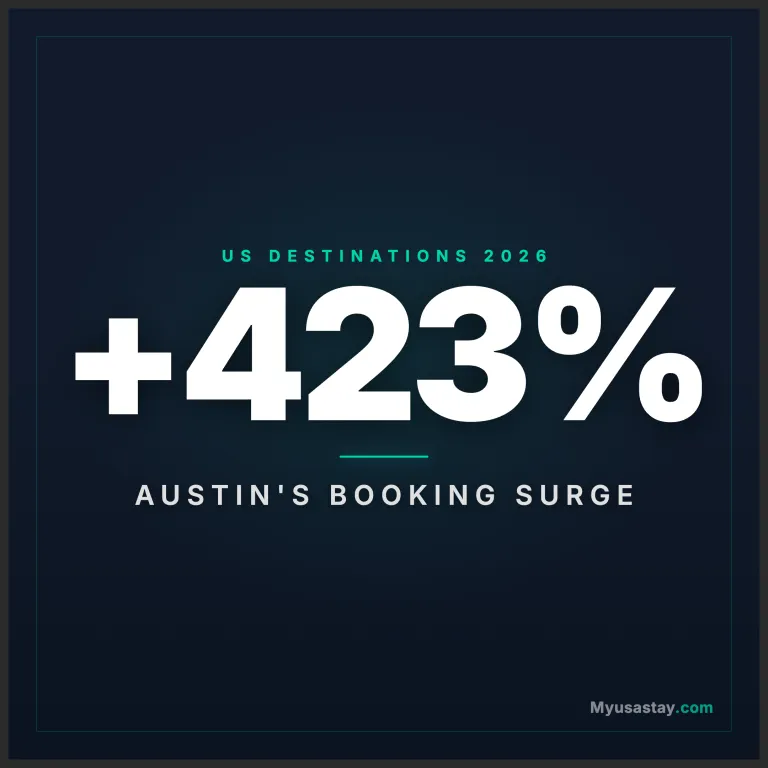
Austin's accommodation searches grew 423% year over year for Summer 2026, according to major travel platform data. The single largest surge of any US city. SXSW drives an annual demand spike. The live music economy generates $5.1 billion annually. The tech sector creates a year-round business travel floor. But 423% is not about any single driver. It reflects a city that has crossed a tipping point where cultural cachet, event density, and infrastructure are compounding.
Barton Springs Pool offers free swimming in the heart of town. Lady Bird Lake kayak tours are among the most popular outdoor activities. The restaurants along South Congress have turned Austin into one of the best food destinations in the country. State parks like McKinney Falls sit minutes from downtown, making this a great base for travelers who love nature and nightlife in the same trip.
5. Los Angeles
Los Angeles drew 3.6 million international visitors in 2024, anchoring its position as the West Coast gateway. California's tourism revenue exceeds $100 billion. The 2028 Olympics infrastructure build is reshaping hotel capacity. SoFi Stadium hosts World Cup matches in 2026.
The best places to explore in LA extend beyond Hollywood. Griffith Park offers free hiking trails. Santa Monica beaches and Venice Beach are perfect for families. The Getty Center, also free, houses world-class art. Food tours through Koreatown are among the best things to do. The city works as a base for day trips to Joshua Tree National Park and Channel Islands National Park.
6. Las Vegas
At $51.5 billion in tourism revenue, Las Vegas answers its own question. Approximately 2.1 million international visitors arrived in 2024. The Formula 1 Grand Prix and recent Super Bowls have created a recurring event cycle. Hotel RevPAR on the Strip outperforms the national average by a wide margin.
Vegas has evolved into a resort destination, a food city, and a gateway to the best national parks in the American West. The Grand Canyon is a four-hour drive. Valley of Fire State Park offers free outdoor hiking. Zion National Park and Death Valley are day-trip distance. The best hotels and resorts on the Strip compete with properties anywhere in the world. Families love the shows, the restaurants, and the free Bellagio fountains.
7. San Francisco
Flight searches to SFO grew 81% year over year according to travel platform data. International arrivals reached 2.3 million in 2024. The culinary scene has regained momentum. As a World Cup host city, San Francisco benefits from event-driven demand. The tech corridor to Silicon Valley adds a business travel floor most vacation destinations lack.
Walking tours replace driving in this city. The cable car to Fisherman's Wharf remains iconic. Golden Gate Park offers free outdoor activities and gardens. Alcatraz Island is one of the most visited national park sites in California. The Mission District and Chinatown restaurants rank among the best food experiences in the state. For coastal scenery, the drive to Big Sur is the perfect day trip from a San Francisco hotel.
8. San Diego
Flight searches grew 47% year over year. Comic-Con generates an annual demand spike. The Tijuana corridor creates a binational metro. Hotel occupancy in the coastal zone tracks above 80%.
San Diego delivers for families who love beaches, outdoor activities, and year-round weather. The Zoo anchors Balboa Park alongside free museums. La Jolla Cove offers beach access and sea lion watching. Coronado Island is home to one of the most beautiful resort hotels in California. Surf lessons, kayak tours, and snorkeling fill the list of best things to do. Cabrillo National Monument provides free park ranger tours with harbor views.
9. Chicago
Approximately 1.4 million international visitors arrived in 2024. Tourism revenue reached $2.5 billion. The Art Institute, Museum Campus, and architectural boat tours draw a higher-spending visitor profile. Summer festivals create consecutive demand waves from June through September.
Lake Michigan's waterfront offers miles of free beaches and outdoor activities. The Field Museum, Shedd Aquarium, and Museum of Science and Industry anchor the family itinerary. Architecture tours along the Chicago River rank among the best things to do in any American city. The restaurants span deep-dish to fine dining. Millennium Park and the Bean are free to explore. This is one of the most underrated vacation destinations in the country.

10. Big Sky, Montana
A leading travel search platform named Big Sky its number one trending destination for 2026. Luxury ski resort investment has doubled capacity. Yellowstone National Park sits 45 minutes away. The wide-open-space premium shows no sign of fading.
This is the perfect base for outdoor adventures. Glacier National Park, with its Going-to-the-Sun Road, is reachable for a multi-day trip. Yellowstone offers free ranger programs, wildlife tours, and landscapes from the Grand Prismatic Spring to Old Faithful. The ranch resorts deliver luxury in a wilderness setting. Mountain biking, fly fishing, and horseback tours fill summer. Planning a Montana vacation means choosing between stunning mountain views and crystal clear rivers every day.
11. Dallas-Fort Worth
Flight bookings to DFW grew 78% ahead of last year, driven by World Cup anticipation. AT&T Stadium hosts group-stage matches. Hotel bookings, restaurant reservations, and car rental demand are tracking at record levels for the June-July corridor.
Dallas surprises travelers. The Arts District is the largest urban arts district in the country, with several museums offering free admission. The Fort Worth Stockyards deliver western heritage tours and great BBQ restaurants. White Rock Lake and Trinity River parks offer hiking and kayak tours. The best hotels downtown put visitors within walking distance of everything worth exploring.
12. Washington, D.C.
Approximately one million international visitors arrived in 2024. The Smithsonian complex remains entirely free. Cherry blossom season generates an estimated $100 million in visitor spending annually.
D.C. is the best city in America for free activities. Twenty-one Smithsonian museums charge nothing. Walking tours of the National Mall, Lincoln Memorial, and Capitol are free. The National Zoo is free. Georgetown's restaurants and waterfront parks add a vacation feel. Rock Creek Park offers hiking trails through the heart of the capital. For families planning an educational trip, no destination in the country matches the list of things to see and do at zero cost.
13. Santa Barbara
Hotel occupancy grew 8 to 9% year over year. Airport passengers increased 11%. The luxury resort segment between Montecito and downtown is attracting new investment from hospitality groups.
Santa Barbara delivers beach vacation atmosphere with wine country tours, coastal dining, and hotel quality that rivals larger cities. Stearns Wharf is one of the most photographed spots on the California coast. Wine tours in the Santa Ynez Valley reach the best vineyards within 30 minutes. For travelers who find LA too big, Santa Barbara is the perfect coastal town alternative.
14. Fort Walton Beach, Florida
Fort Walton Beach appeared as a rising pick for affordable Gulf Coast beach vacations. Sugar-white sand, lower rates than Destin or Panama City Beach, and strong search growth make the case.
Henderson Beach State Park offers some of the most beautiful free beach access in Florida. Fishing tours, dolphin watching, and snorkeling at Crab Island are among the best outdoor activities. The town is family friendly with vacation rentals and hotels for every budget. This is one of those hidden gem beaches with crystal clear water worth checking before the rest of the country catches on.
15. Carlsbad, California
Carlsbad registered extraordinary search growth, earning multiple trending destinations spots for 2026. Between San Diego and Orange County, it offers LEGOLAND, the Flower Fields, and a small town coastal atmosphere.
The beaches are less crowded than San Diego. Resort hotels offer stay-and-play packages with LEGOLAND. Free coastal trail walks, tide pools, and outdoor activities at Batiquitos Lagoon round out the family itinerary. Restaurants specialize in fresh seafood. For a California beach vacation with kids, Carlsbad ranks among the best small town alternatives.
The destinations that changed the most: surge tracker
We compiled the year-over-year demand changes. These are the numbers tourism boards and travel writers will reference through the rest of the year.
- Austin: accommodation searches +423% (major platform data, Summer 2026)
- San Francisco: flight searches +81% (travel platform data)
- Dallas-Fort Worth: flight bookings +78% (airline data)
- World Cup host cities: short-term rental searches +80% (platform data)
- Houston: accommodation searches +52% (travel platform data)
- San Diego: flight searches +47% (travel platform data)
- Florida cities (average): accommodation searches +43% (travel platform data)
- July 4 hotels (national): demand +48% (industry data)
- US domestic overall: accommodation searches +21%, flight searches +29% (travel platform data)
Texas and California are absorbing disproportionate demand growth. Florida remains the volume leader at a more moderate rate. The World Cup effect is measurable. The domestic baseline of +21% means even cities not on any trending list are seeing growth for hotels, resorts, and vacation rentals across the country.
US travel by the numbers: 2025-2026 key statistics
- Total US travel spending forecast: $1.37 trillion in 2026, climbing to $1.42 trillion in 2027 (U.S. Travel Association)
- International visitors to the US: 72.4 million in 2024, 77.1 million forecast for 2025 (NTTO)
- Domestic travel share: 87% of total spending ($1.20 trillion), returned to 2019 inflation-adjusted levels
- Average international visitor spend: $2,970. World Cup travelers projected above $5,000
- Hotel RevPAR growth: +2.9% in 2026. Demand (3.2%) outpacing supply (2.3%) (PwC, CoStar)
- Domestic accommodation searches: +21% year over year. Flights: +29% (travel platform data)
- Social conversation about domestic vacations: +77% globally, doubled in the US
- FIFA World Cup 2026 projected US impact: $17 billion GDP, 185,000 jobs (FIFA)
- Orlando all-time record: 76.7 million visitors in 2025
- 63% of US travelers planning a domestic trip this summer (industry survey)
- Tourism supports approximately $3 trillion in GDP and 15 million jobs
What is driving the shift: 3 forces reshaping US travel
The domestic pivot
Sixty-three percent of Americans are planning a domestic vacation this summer. Social media conversation about US vacations has doubled. Families are rediscovering national parks, American beaches, and small town resorts within a day's drive. The domestic pivot is a structural preference shift supported by lower costs and an expanding list of destinations, from outdoor adventures in Montana to food tours in Texas.
Event-driven demand
The World Cup spans 11 host cities over seven weeks. But it sits within a broader event economy: Epic Universe in Orlando, the Formula 1 Las Vegas Grand Prix, SXSW in Austin, Comic-Con in San Diego. We analyzed booking patterns at hotels around these events and found demand spikes extending 10 to 14 days beyond event dates. For travelers planning vacations around events, the best time to visit is often just before or after.
Screen-inspired travel
Fifty-three percent of travelers say their desire for screen-inspired trips has grown. Among Gen Z and Millennials, 81% plan getaways based on content seen on screen. National parks, coastal towns, and island locations that appear on screen become instant travel destinations. Screen-inspired travel is a quantifiable channel for the most popular places to visit in America.
FAQ: your questions about US travel destinations
What is the most visited city in the US?
New York City leads for international visitors with 9.5 million overseas arrivals in 2024. For total visitors, Orlando holds the record at 76.7 million in 2025. Both cities offer free museums, world-class hotels, restaurants, and tours for every type of traveler.
What US destination is growing the fastest in 2026?
Austin leads with a 423% surge in accommodation searches for Summer 2026. San Francisco flight searches grew 81%. Big Sky, Montana topped trending destination lists, driven by Yellowstone National Park and luxury resort development.
How much do Americans spend on travel?
US travel spending is forecast to hit $1.37 trillion in 2026, with 87% from domestic travel. The average international visitor spends $2,970 on hotels, tours, restaurants, and activities. Family vacations, outdoor adventures, and city breaks all drive the total higher.
Which US cities are hosting the 2026 FIFA World Cup?
Eleven cities: New York/New Jersey (MetLife Stadium, including the final), Los Angeles (SoFi Stadium), Miami, Dallas, Houston, Atlanta, Seattle, Boston/Foxborough, Philadelphia, Kansas City, and the San Francisco Bay Area. Hotels and resorts in host cities are reporting record booking levels. The best time to visit is during match weeks, when entire towns transform into outdoor festivals.