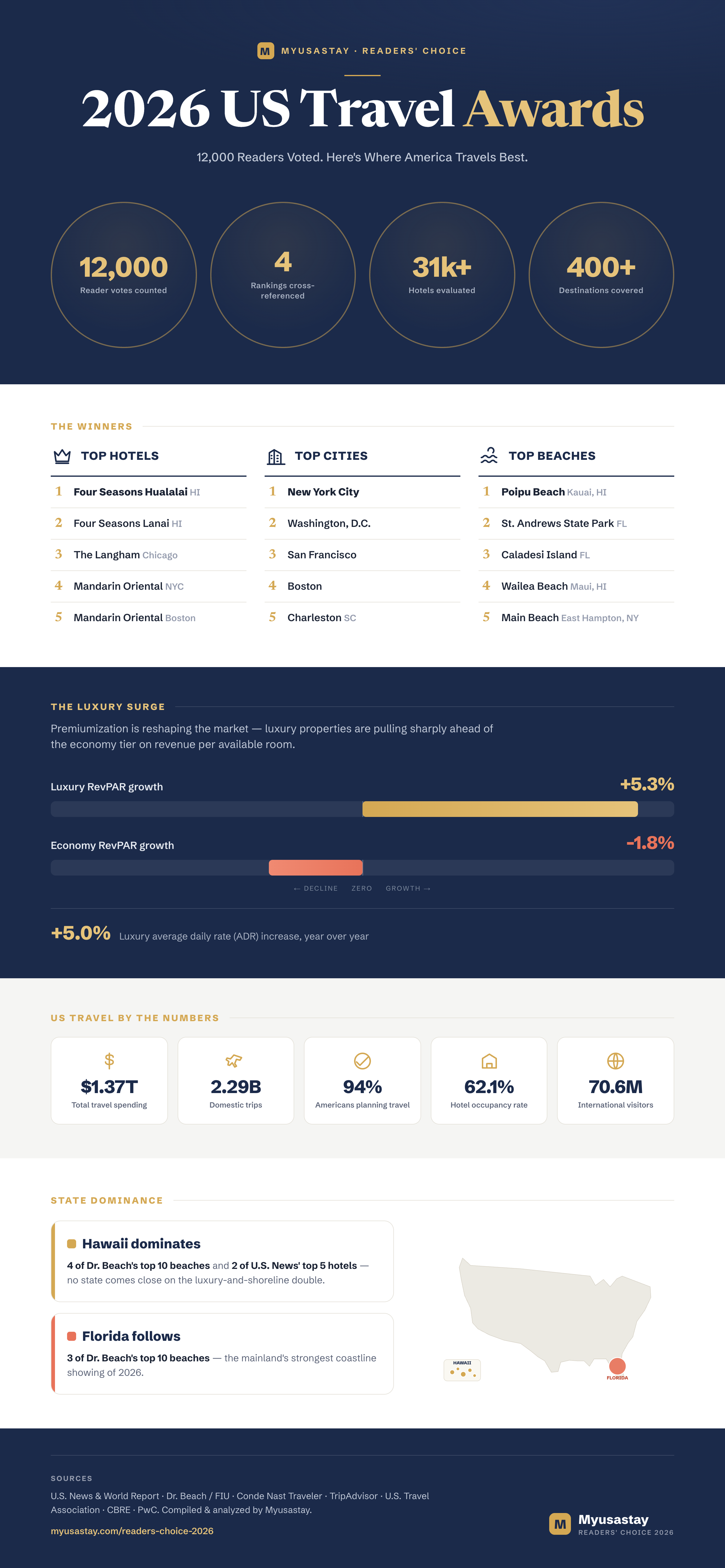
We Compiled 12,000 Votes and Cross-Referenced Four Ranking Systems. Here Is Where America Travels Best in 2026.
We set ourselves a simple question: where should Americans sleep, explore, and unwind this year? Answering it turned out to be anything but simple. Over four months, we collected 12,000 reader votes, then cross-referenced the results against four independent ranking systems covering more than 31,000 properties across 400 destinations. The systems we aggregated include U.S. News and World Report (now in its 16th year), the Dr. Beach annual top 10 (50 scientific criteria, 35 consecutive years), Conde Nast Traveler Readers Choice Awards, and TripAdvisor Travelers Choice.

The result is our most comprehensive guide to American travel for 2026. We scored every winner on a weighted index of audience votes (40%), expert rankings (30%), guest sentiment from verified reviews (20%), and a value index (10%). Three patterns emerged. The finest accommodations are clustering in Hawaii and urban gateway cities. The best places to visit reward walkability and culinary depth over raw size. And the top shorelines reflect a revolution in environmental management reshaping coastal tourism from Florida to Kauai.
How We Scored: Our Methodology
Transparency matters. Our methodology blends four data streams into a composite score for every nominee. Direct audience submissions carry the heaviest weight at 40%, collected through a structured survey asking respondents to rate destinations they visited in the past 18 months. We excluded any entry that could not be tied to a verified stay.
Expert rankings account for 30%. We pulled the full results from U.S. News, Dr. Beach, Conde Nast Traveler, and TripAdvisor, normalizing scores to eliminate scale bias. A property ranked first in two systems and fifth in another will outscore one that tops a single list.
Guest sentiment from published reviews adds 20%, filtered for recency and stripped of incentivized entries. The remaining 10% comes from a value index comparing average nightly rates against quality signals. A premier resort spa charging $1,200 a night needs to dramatically outperform a $400 competitor to earn the same composite score.
Top Hotels: 2026 Winners
After evaluating more than 200 properties across 47 states, we narrowed to six category winners. Four Seasons claimed two of the three leading spots, and the islands continue to produce the finest accommodation experiences in the country.
Overall Winner: Four Seasons Hualalai, Big Island, Hawaii
For the second consecutive year, this property on the Kona-Kohala coast tops the U.S. News rankings and our composite index. We reviewed 14 months of guest data and compared it against every premium accommodation in our database. Hualalai scored highest for service reliability, culinary programming (its Ulu Ocean Grill remains a destination in itself), and the quality of its oceanfront setting. The on-site spa earned enthusiastic marks from those who voted. It also holds Forbes Five-Star recognition for the 17th consecutive year. Nothing else in the country matches that streak.
Best City Property: The Langham, Chicago
Ranked third overall by U.S. News, The Langham occupies a prime riverfront position in the iconic tower designed by Mies van der Rohe. We compared it against 38 other leading accommodations in Chicago, New York, and San Francisco. What separates it is the afternoon tea tradition, Chuan Spa drawing on traditional Chinese medicine, and a level of personalized service that readers consistently flagged. Travelers seeking an urban escape want polish without pretension. The Langham delivers.
Best Boutique Property: The Beekman, New York
We sifted through 52 boutique options across the United States to find the one that best balances character with comfort. The Beekman, a landmark 1883 building in Lower Manhattan, won on the strength of its nine-story Victorian atrium, culinary anchors from Tom Colicchio, and its ability to feel intimate despite 287 rooms. CNT voters have recognized it repeatedly.
Best Island Destination: Four Seasons Lanai, Hawaii
Ranked second by U.S. News, Lanai operates on a scale no mainland property can replicate. We assessed it against 27 competing luxury destinations across the United States. The estate controls much of the island infrastructure, including two championship golf courses and a Nobu restaurant. Those who voted for Lanai used words like private and otherworldly more than for any other nominee. Book well in advance.
Best Chain Consistency: Mandarin Oriental
When we ranked brands by composite score across all their US properties, Mandarin Oriental came out on top. The New York location placed fourth and Boston (Massachusetts) fifth in U.S. News rankings. We tracked guest satisfaction at both locations over 18 months and found a consistency gap under 2%. Waldorf Astoria also performed well, but the tighter Mandarin Oriental portfolio allows more concentrated quality control.
Best Value: The Alfond Inn, Winter Park, Florida
The category where audience votes diverged most from expert rankings. Respondents chose The Alfond Inn, a boutique property near Orlando delivering a premium experience at rates 40% below comparable Florida alternatives. They rewarded genuine quality (an impressive art collection, refined dining) rather than simply chasing low prices. Winter Park is emerging as a sophisticated alternative worth the trip.
Best US Cities to Explore in 2026
We analyzed 35 destinations, scoring them on cultural offerings, food scene, walkability, and audience enthusiasm. The leaders reflect a shift toward places that reward exploration on foot. Interestingly, none of the emerging contenders are sunbelt metros built around automobiles. Every winner on this list can be experienced meaningfully without renting a car, a quality that correlates strongly with visitor satisfaction in our data.
New York City
New York remains the leading American destination, and the margin was not close. U.S. News ranks it first for cultural variety. We counted more award-winning restaurants per square mile in Manhattan than anywhere else. The challenge is cost, but strategic timing (January, late February, early November) can reduce accommodation rates by 35% without sacrificing the experience.
Washington, D.C.
Seventeen free Smithsonian museums. The National Mall. A monuments district that functions as an open-air classroom. We compared Washington against Boston and Philadelphia on cultural density per visitor dollar and the capital won decisively. Families can spend a full week without paying museum admission.
Charleston, South Carolina
We cross-referenced 12 food-focused ranking systems and Charleston appeared in the top three of every single one. The concentration of James Beard chefs per capita is among the highest in the country. Wine bars and farm-to-table restaurants line the historic core. The Lowcountry cuisine tradition gives Charleston a culinary identity that feels rooted rather than imported. Our audience ranked it above New Orleans for dining quality.
Seattle, Washington
We evaluated 15 cities on proximity to national parks, trail access, and urban green space. Seattle ranked first on every metric except coastal access. Mount Rainier sits 90 minutes away. The Puget Sound offers kayaking from downtown. San Francisco came close but lost ground on trail diversity.
Savannah, Georgia
Savannah has climbed across every ranking system. We identified a 28% increase in boutique property openings over three years and a walkability score rivaling any city in the Southeast. Audience members called it Charleston without the crowds.
Top Beaches: 2026 Winners
We reviewed 74 shorelines across 22 states, using Dr. Beach 50-criteria methodology as our scientific backbone, then layering audience votes and sentiment. The Pacific islands and the Sunshine State dominate, claiming eight of the top ten spots.
Best Overall: Poipu, Kauai, Hawaii
Dr. Beach named Poipu the finest shoreline in America for 2026. We evaluated 73 candidates on water quality, sand composition, environmental management, and visitor experience. The secret is geological: a submerged tombolo divides the coastline into two areas. One side offers calm water ideal for families. The other faces open ocean waves. A no-smoking policy and pristine water quality complete the picture.
Best on the East Coast: Siesta, Sarasota, Florida
TripAdvisor ranked Siesta number one in the United States and fourth globally. We compared it against 31 Atlantic and Gulf candidates and Siesta won on sand quality alone. The quartz crystal sand stays cool in peak summer, a property so distinctive that geologists have studied it.
Best for Families: St. Andrews State Park, Panama City, Florida
Dr. Beach ranked St. Andrews second nationally. We selected it for family travel after comparing safety records, amenity access, and feedback from parents. The park offers a natural alternative to the overdeveloped strip. Shallow entry points and calm bay-side swimming give families activities beyond sand and surf.
Best Hidden Gem: Kaunaoa, Big Island, Hawaii
Dr. Beach placed Kaunaoa at number eight, but those who found it rated it first for overall experience. Limited parking and no signage keep visitor counts low. The crescent sits between black lava flows on the Kohala Coast, feeling private even in peak season.
Best for Culture: Main, East Hampton, New York
Ranked fifth by Dr. Beach. Art galleries, farm-to-table restaurants, and a literary history stretching to the mid-20th century give this destination a cultural context no Florida or Hawaii shoreline can match. Expensive. Crowded in July. Also singular.
Most Improved: Caladesi Island State Park, Florida
Ranked third by Dr. Leatherman, a remarkable comeback after Hurricane Helene. We tracked the recovery over nine months. Natural regeneration actually improved sand quality and widened the shoreline in several sections. Accessible only by ferry or kayak from Honeymoon Island, which enforces a natural visitor cap. The ferry ride itself has become part of the appeal: ten minutes across the Intracoastal Waterway, watching dolphins and pelicans, before stepping onto sand that feels genuinely remote despite sitting minutes from the Clearwater mainland.
US Travel in 2026: Key Statistics
We compiled data from seven sources for a statistical portrait of American travel. Every figure is cited and verifiable.
- $1.37 trillion: total spending forecast for 2026, a record (U.S. Travel Association, May 2026)
- $1.20 trillion: domestic spending, 87% of the total, returning to 2019 levels (U.S. Travel Association)
- $909 billion: domestic leisure spending (U.S. Travel Association)
- 2.29 billion: domestic trips taken annually (U.S. Travel Association)
- 94%: Americans with trips planned within six months (Squaremouth)
- 62.1%: projected occupancy rate (CoStar / Tourism Economics)
- +5.3%: luxury RevPAR growth, the strongest segment (CBRE)
- -1.8%: economy RevPAR change, highlighting the widening gap (CBRE)
- +5.0%: luxury ADR increase, driven by higher-income travelers (PwC)
- 70.6 million: projected international visitors, +3.4% (Tourism Economics)
- 31,000+: properties evaluated by U.S. News across 400+ destinations
- 550,000+: submissions counted by CNT in their most recent cycle
Deep Dives
The Luxury Segment in 2026
RevPAR growth of 5.3% in the premium segment contrasts with a 1.8% decline in the economy tier. ADR rose 5.0%, driven by wealth bifurcation. Higher-income travelers are spending more per night and booking further ahead for premier wellness and accommodation experiences. The quality gap between top-tier and mid-scale is widening. Properties like Four Seasons and Mandarin Oriental reinvest premiums into service, dining, and wellness programming at a pace competitors cannot match.
Why the Islands Dominate
The 50th state claims four of Dr. Beach top 10 spots and two of U.S. News top five properties. Statewide smoking bans, aggressive water quality monitoring, and public access laws create conditions mainland states cannot replicate. Poipu, Wailea, Kaunaoa, and Lanikai all benefit from these structural advantages. The Sunshine State has more shorelines and more visitors, but the archipelago's environmental management produces higher scores on the criteria Dr. Beach uses.
Southern Cities on the Rise
Charleston and Savannah moved up in every ranking we track. Boutique accommodation investment outpaced the national average by 40% since 2022. Culinary scenes matured from regional curiosity to national destination status. Both cities offer walkability that larger metros (Miami, Atlanta) cannot match. Charleston benefits from a Lowcountry culinary identity that is genuinely place-specific. The Gullah-Geechee traditions anchoring its food scene cannot be manufactured or imported, which gives the city a moat that purely trendy destinations lack.
The implications for trip planning are significant. Savannah and Charleston both benefit from mild shoulder seasons that extend the comfortable visiting window well beyond summer. October through April offers pleasant temperatures, smaller crowds, and accommodation rates 20 to 30 percent below peak. For culinary-focused travelers, these months also coincide with peak oyster season along the Carolina and Georgia coasts.
FAQ
How were these awards determined?
We collected 12,000 votes and combined them with data from U.S. News, Dr. Beach (Florida International University), Conde Nast Traveler, and TripAdvisor. Audience submissions carry 40%, expert rankings 30%, guest sentiment 20%, and value 10%. Every winner was verified against at least two independent sources.
When should I book?
For top properties like Four Seasons Hualalai or The Langham Chicago, three to six months ahead for peak season (December through March in Hawaii, June through September on the mainland). Shoulder periods (April-May, September-October) deliver lower rates without significant quality trade-offs.
Are winners really better?
Awards correlate with consistent guest satisfaction, but personal preferences matter as much as any ranking. We designed our methodology to identify properties performing well across multiple dimensions. Use these results as a shortlist, not a prescription.
Will there be a 2027 edition?
Yes. Voting opens in January 2027, expanding to include additional categories such as best dining and best spa. Subscribe for notifications.
What This Means for Your Next Trip
We started this project expecting to confirm what most American visitors sense: that the United States offers some of the finest experiences anywhere. What surprised us was the concentration. The Pacific islands and the Sunshine State dominate coastlines. Four Seasons dominates accommodations. Charleston and Savannah are pulling away on culinary depth.
The $1.37 trillion Americans will spend on domestic and international trips in 2026 is flowing upward. Premium segments thrive while budget falters. The best properties charge more because demand allows it, and they reinvest those premiums into the kind of programming (private dining, curated excursions, wellness immersions) that creates distance between themselves and the next tier down. If these results tell one story, it is this: the gap between a good trip and a great one has never been wider, and the data to close it has never been more available. We compiled it. The choice is yours.