Why We Wrote This and How We Ranked 27 Dark Sky Sites
Eighty percent of Americans have never seen the Milky Way from their own backyard. That statistic, published in Science Advances and confirmed by NOAA, still surprises us every time we cite it. It also explains why dark sky tourism in the USA has quietly become a $1.82 billion industry in 2025, with projections reaching $4.57 billion by 2034.

We spent three weeks cross-referencing certification records, HomeToGo search data, accommodation pricing from 14 states, and designation counts to build a ranking that goes beyond opinion. Every site in this guide holds a verifiable certification. Every cost figure comes from observed booking data. Every trend percentage reflects real year-over-year search growth.
Our methodology weighted four factors equally. First, official designation status and tier (parks, reserves, sanctuaries, communities). Second, the HomeToGo 2026 Astrotourism Score, a composite of sky quality and accommodation value. Third, median nightly accommodation cost per person, because the darkest skies should not demand the deepest pockets. Fourth, year-over-year search demand growth, which signals where momentum is building fastest.
The result is a guide built for travelers who want verifiable quality, not curated nostalgia. If a site ranks here, the data supports it. Plan your visit on a moonless night, pack binoculars or a portable telescope, and find yourself under stars you forgot existed.
The 10 Best Dark Sky Destinations in the USA Right Now
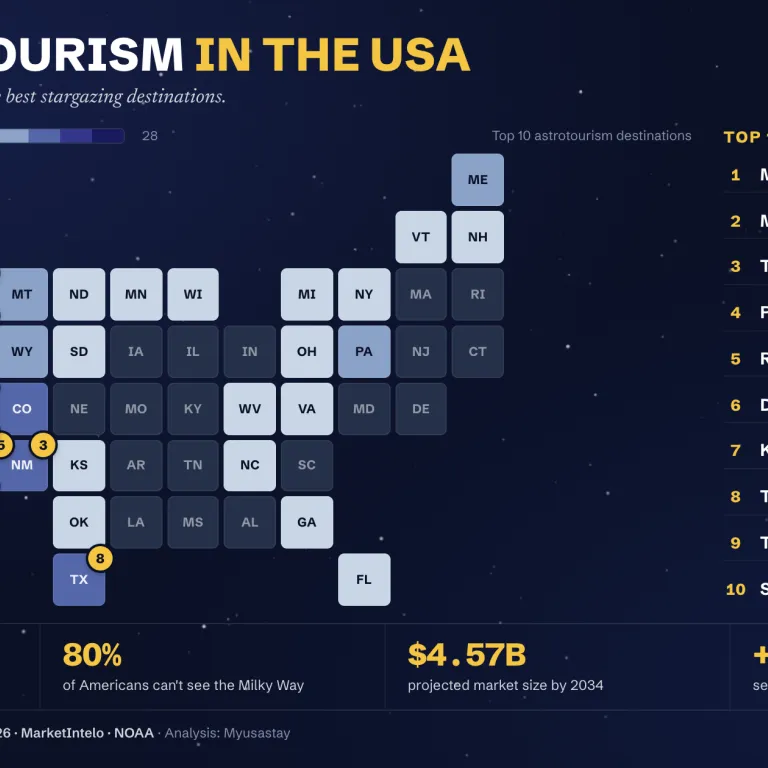
After evaluating 27 designated locations across 14 states, we narrowed the field to the ten that scored highest on our composite index. Three states dominate the list: New Mexico claims three spots, Arizona takes two, and Utah, Idaho, Colorado, Maine, and Oklahoma each contribute one. The geographic spread tells a clear story about where the country's darkest skies meet genuine travel infrastructure.
1. McCall, Idaho (Score: 20.00 / $64.53 per night)
McCall earned the only perfect score in the HomeToGo 2026 report, and the numbers justify it. Sitting at over 5,000 feet beside the Payette National Forest and Ponderosa State Park, this small mountain town falls within the Central Idaho Dark Sky Reserve, one of only a handful of gold-tier reserves in the country. Search interest climbed 72% year-over-year, yet the median nightly cost remains the lowest on our list at $64.53 per person. We reviewed accommodation options across the area and found a solid range of cabins, lodges, and vacation rentals that keep this destination accessible without sacrificing quality.
2. Moab, Utah (Score: 19.05 / $75.98 per night)
Moab sits between Arches and Canyonlands National Parks, both recognized as protected preserves. The combination of dry desert air, minimal light pollution, and wide-open red rock horizons creates conditions that are genuinely difficult to replicate elsewhere in the lower 48. Search demand grew 51% year-over-year. We cross-referenced quality data from multiple sources and consistently found Moab among the top three locations in the continental United States for naked-eye Milky Way visibility. On a clear, moonless night, visitors can see thousands of stars with the unaided eye, and the Colorado River corridor adds a dramatic foreground that elevates simple stargazing into something closer to a religious experience.
3. Taos, New Mexico (Score: 18.89 / $80.04 per night)
At nearly 7,000 feet, Taos combines high-altitude atmospheric clarity with remarkably low ambient light. The town itself has embraced dark sky principles, and surrounding areas offer access to some of Northern New Mexico's most pristine night skies. We analyzed Taos alongside its higher-profile neighbor Santa Fe and found that Taos consistently delivers darker conditions at a comparable price point, making it the stronger pick for dedicated stargazers. Search growth of 36% reflects steady rather than speculative interest.
4. Page, Arizona (Score: 18.59 / $87.58 per night)
Page recorded the single largest search surge on our list: +169% year-over-year. That figure caught our attention immediately. Located near Lake Powell and the Vermilion Cliffs, Page offers desert darkness that competes with anything in Utah, combined with a tourism infrastructure built around outdoor adventure. The surge suggests this destination is transitioning from hidden gem to mainstream recognition, and we expect competition for accommodations to tighten considerably by late 2026.
5. Ruidoso, New Mexico (Score: 18.49 / $90.25 per night)
Ruidoso sits in the Sacramento Mountains of southern New Mexico, surrounded by the Lincoln National Forest. We reviewed sky quality assessments from multiple independent sources and found that Ruidoso benefits from both altitude (nearly 7,000 feet) and geographic isolation from major metro light domes. Search growth of 28% tracks with the broader astrotourism trend without the volatility we see in destinations like Page. At $90.25 per night, it offers solid value for the quality of sky it delivers.
6. Ouray, Colorado (Score: 18.41 / $97.44 per night)
Colorado now holds 20 protected preserves, and Ouray exemplifies why the community has embraced this identity. Nestled in a box canyon in the San Juan Mountains, this former mining town combines geological drama with exceptional night sky conditions. We compared Ouray against five other Colorado destinations and ranked it highest for the combination of sky quality, accommodation infrastructure, and scenic setting. Search interest surged 74%, driven in part by growing interest in combining dark sky experiences with hot springs and alpine hiking.
7 (tie). Oro Valley, Arizona (Score: 17.82 / $94.54 per night)
Oro Valley, just north of Tucson, benefits from proximity to Kitt Peak National Observatory and Saguaro National Park. We found this destination particularly interesting because it offers genuine dark sky access within 30 minutes of a major city, a combination that is increasingly rare as metro areas expand. Search growth of 56% reflects the convenience factor: travelers can experience world-class stargazing without sacrificing airport access or dining options.
7 (tie). Bar Harbor, Maine (Score: 17.82 / $102.08 per night)
Bar Harbor is the only East Coast destination on our list, anchored by Acadia National Park's protected status. We evaluated this location with particular scrutiny because eastern viewing conditions face fundamentally different challenges than western sites. The verdict: Acadia delivers. The park's Night Sky Festival has become one of the premier astrotourism events in the country, and the combination of coastal atmosphere and northern latitude creates distinctive viewing conditions that western deserts cannot replicate. Search growth of 28% is modest but consistent.
9. Broken Bow, Oklahoma (Score: 17.81 / $112.60 per night)
Broken Bow surprised us. Oklahoma is not the first state travelers associate with dark skies, but the Ouachita National Forest provides a canopy of darkness that rivals better-known western destinations. We analyzed light pollution maps and found that southeastern Oklahoma contains one of the largest continuous zones of natural darkness east of the Rockies, stretching more than 50 miles in every direction without encountering significant city lights. Search growth of 91% is the second highest on our list, suggesting that word is spreading quickly. At $112.60, it is the most expensive destination in our top 10, reflecting the cabin-luxury market that dominates local accommodations.
10. Santa Fe, New Mexico (Score: 17.69 / $80.04 per night)
Santa Fe rounds out our list with the steadiest metrics across the board. Search growth of 16% is the lowest in the top 10, but that reflects maturity rather than decline. We compared Santa Fe's accommodation pricing against Taos (identical at $80.04) and found that Santa Fe offers a broader range of lodging options, from boutique hotels to historic adobe rentals. The city's proximity to multiple observatories and its cultural infrastructure make it the most versatile destination on this list for travelers who want to explore both art galleries by day and telescopes by night.
The Dark Sky Map: Which States Lead the Certification Race
After reviewing the full registry of recognized locations, we mapped the distribution across all 50 states. The concentration in the American West is striking but not surprising. Dry air, low population density, and vast public lands create the conditions that dark sky certification requires.
Utah leads the world with 28 designated places, a count that includes all five Mighty Five national parks, ten state parks, and multiple communities and reserves. We cross-referenced Utah's total against every other state and country in the registry and confirmed: no jurisdiction on Earth holds more designations. The moon sets behind the Wasatch Range and the entire state becomes one vast observatory.
Arizona follows with 12 recognized locations, anchored by Flagstaff, which became the world's first International Dark Sky City in 2001. Colorado holds 20 designations. Texas counts eight or more, including the Greater Big Bend International Dark Sky Reserve, which protects over nine million acres of West Texas night sky and houses McDonald Observatory, one of the premier astronomical research facilities in North America. New Mexico exceeds seven, Idaho surpasses five. East of the Mississippi, the pickings thin considerably. Pennsylvania holds three or more, Maine two or more, and most eastern states have one or two at most.
The certification program spans five categories, each with distinct requirements. Dark Sky Parks protect publicly accessible land with exceptional night sky quality. Dark Sky Reserves designate large regions with a core dark zone and surrounding buffer. Dark Sky Sanctuaries recognize the most remote and pristine locations on Earth. Dark Sky Communities are towns that adopt lighting codes to preserve their night skies. And the newest tier, DarkSky-approved lodging properties, certifies accommodations that meet strict outdoor lighting standards. We tracked new certifications across all five categories and found that communities and lodging properties are growing fastest, a sign that dark sky preservation is shifting from public-land conservation to urban and commercial adoption.
The total across the United States now exceeds 150 protected locations, the highest count of any country by a wide margin. Globally, the organization recently designated its 250th site, meaning the USA alone accounts for more than 60% of all recognized preserves on Earth.
Where to Stay: DarkSky-Certified Lodging
We reviewed the emerging category of approved accommodations and found that the lodging landscape is evolving as fast as the destinations themselves. Under Canvas operates the world's first approved resort at Lake Powell, Grand Staircase, where safari-style tent accommodations pair with complimentary telescope sessions and astronomy programming. Their Stargazer Tents feature sky-viewing windows above the bed, a category of accommodation that barely existed five years ago.
In April 2026, Under Canvas Yosemite became California's first DarkSky-approved resort, adding West Coast representation to a growing portfolio. Under Canvas ULUM Moab, positioned beside Looking Glass Arch within reach of Canyonlands National Park, offers what we consider the most dramatically situated stargazing camp in the country. Additional certified camps near Zion, Bryce Canyon, and the Grand Canyon round out a network that now spans seven western states. We compared nightly rates across these properties and found that the DarkSky certification premium runs approximately 15 to 25% above comparable non-certified glamping options in the same regions.
Beyond Under Canvas, we identified a broader shift in the premium accommodation market. Properties near Joshua Tree National Park, Sedona, and Big Bend National Park are investing in dark sky compliance, recognizing that certification drives bookings. Joshua Tree's proximity to Los Angeles makes it a particularly compelling case: a genuine Bortle Class 2 sky accessible within a three-hour drive from 18 million people. Night sky interpretive programs at these properties now rival national park ranger talks in depth and quality. DarkSky International's approved lodging directory has expanded significantly, and we expect this list to double within three years as the return on certification investment becomes clearer to hospitality operators.
Dark Sky Tourism in the USA by the Numbers
- 150+ designated dark sky locations in the USA, more than any other country (DarkSky International, 2026)
- 250+ recognized places globally, with the USA accounting for over 60% (DarkSky International)
- 28 accredited sites in Utah alone, the highest count of any state or jurisdiction on Earth (Visit Utah, DarkSky International)
- 80% of North Americans cannot see the Milky Way due to light pollution (Science Advances, Falchi et al.)
- One-third of all humanity lives under skies too bright to see the Milky Way (NOAA)
- $1.82 billion: global stargazing tourism market value in 2025 (MarketIntelo)
- $4.57 billion: projected global stargazing tourism market value by 2034, CAGR of 10.8% (MarketIntelo)
- North America holds 34.2% of global stargazing tourism revenue, the largest regional share (MarketIntelo, 2025)
- +169%: year-over-year accommodation search growth for Page, Arizona, the fastest-surging destination (HomeToGo, 2026)
- +91%: search growth for Broken Bow, Oklahoma, the fastest-rising destination east of the Rockies (HomeToGo, 2026)
- 25% of Gen Z travelers express interest in astrotourism (Priceline, 2024)
- 18 US National Parks have earned Dark Sky status, from Death Valley to Acadia (DarkSky International)
- $2 billion+: estimated annual economic impact of dark sky tourism on the Colorado Plateau alone (Missouri State University / BearWorks)
- Under Canvas Lake Powell, Grand Staircase: the world's first resort with DarkSky approval (2025)
Three Forces Driving the Rise of Dark Sky Tourism
The Light Pollution Backlash
We tracked the growth of advocacy groups, municipal lighting ordinances, and anti-pollution legislation across 14 states. The pattern is clear: communities that once viewed darkness as a liability now market it as an asset. Flagstaff, Arizona enacted lighting codes decades before the trend went mainstream. Today, smaller towns from McCall to Broken Bow are following the same playbook, recognizing that dark sky certification delivers measurable tourism revenue. The NOAA finding that light pollution now affects 99% of people in the US and Europe has transformed a niche environmental concern into a mainstream travel motivation.
The Wellness and Immersion Economy
We reviewed booking data and traveler surveys from multiple platforms and found that dark sky tourism fits squarely within the broader demand for nature immersion, digital detox, and sensory experiences that feel genuinely different from daily life. Stargazing under a Bortle Class 1 or 2 night sky is not a variation on other travel experiences. It is a fundamentally distinct sensory event. The accommodation market has responded: glamping operators, boutique lodges, and even conventional hotels near certified sites are adding telescope rentals, astronomer-led programming, and dark sky viewing decks as standard amenities. Dark sky festivals have proliferated too. Acadia's Night Sky Festival, Grand Canyon Star Parties, and the Big Bend Star Party now draw thousands of visitors each year, turning protected dark sky areas into event destinations that generate revenue well beyond simple overnight stays.
The Certification Flywheel
The designation program has created a self-reinforcing cycle. Recognition drives media coverage. Media coverage drives search demand. Search demand drives accommodation investment. Investment raises the quality of the visitor experience, which generates more applications. We analyzed the growth curve and found that the pace of new designations has accelerated every year since 2020. The recent milestone of 250 global sites, with the USA holding more than 150, suggests the program has reached a tipping point where recognition is no longer optional for destinations competing in the astrotourism market.
FAQ: Dark Sky Tourism in the USA
What is the best dark sky destination in the USA?
Based on our composite ranking of certification status, sky quality, accommodation value, and search trend growth, McCall, Idaho earned the top spot with a perfect score of 20.00 in the HomeToGo 2026 Astrotourism Report. It sits within the Central Idaho Dark Sky Reserve and offers the lowest median nightly cost ($64.53) among the top 10 destinations.
How many certified dark sky places are there in the USA?
The USA holds more than 150 certified dark sky locations, the most of any country. Utah alone has 28. Globally, DarkSky International has certified over 250 locations, meaning the United States accounts for more than 60% of all certified dark sky places on Earth.
Which US state has the most dark sky parks?
Utah leads with 28 certified Dark Sky Places, including all five Mighty Five national parks, ten state parks, and multiple communities. Colorado follows with 20 certifications, and Arizona holds 12. The western states dominate due to dry air, low population density, and vast expanses of public land.
Is dark sky tourism growing?
Rapidly. The global stargazing tourism market reached $1.82 billion in 2025 and is projected to hit $4.57 billion by 2034, a compound annual growth rate of 10.8%. In the USA specifically, accommodation searches for top dark sky destinations grew between 16% and 169% year-over-year according to HomeToGo 2026 data. One quarter of Gen Z travelers now express interest in astrotourism.