What 1,500 Luxury Travelers Told Us About 2026 (and Why the Industry Should Listen)
We spent four months surveying 1,500 high-net-worth travelers across the United States, cross-referencing their answers against data from Virtuoso, Deloitte, American Express and 14 other industry sources. The goal was simple: find out what luxury travelers actually want, and which trends are real versus hype. Some answers confirmed what the global travel industry already suspected. Others turned conventional wisdom on its head.

The headline finding surprised even us. When we asked respondents to rank what mattered most on their next trip, "exclusive access" dropped to seventh place. The top slot went to something far less glamorous: personal renewal. In a year where the global premium market is projected to reach 1.77 trillion dollars, the people spending the most are quietly rewriting the definition of what matters.
The Luxury Travel Market in 2026: Scale and Momentum
Some context on the forces shaping these responses. Global premium spending is expected to hit approximately 1.77 trillion dollars in 2025, with projections pointing toward 2.1 trillion by 2030 at a compound annual growth rate between 3.4% and 8.5%, depending on the segment. North America captures roughly 32% of that global travel market. Europe follows closely at 29-34%, reflecting the enduring draw of France, Italy and increasingly the Middle East.
The wealthiest 10% of U.S. households now account for 544 billion dollars in annual leisure spending. The top 1% spend an average of 12,400 dollars per trip, up from 8,400 just three years earlier, and they take six trips per year compared to the national average of 2.8. Virtuoso projects that itineraries exceeding 50,000 dollars will rise 35% for the 2026-2027 season. The Virtuoso Luxe Report, drawn from over 2,400 travel advisors across 58 countries, paints a picture of sustained momentum: 67% foresee a slight to significant increase in demand, and 45% have seen a rise in ultraluxe requests specifically.
Yet the real story is not the total amount. It is who is spending. Card-spend data from Deloitte shows that combined outlays by Millennials and Generation Z on premium travel products have overtaken Generation X for the first time. Nearly 4 in 10 Gen Z travelers (38%) and 40% of Millennials are planning upscale stays in 2026. High-income Millennials book at 1.2 times the frequency of other groups and budget 1.6 times more for their marquee trips. Women drive up to 80% of booking decisions across all segments, and those aged 41-60 still account for 42.8% of revenue, but the generational shift is unmistakable.
Finding 1: Personal Renewal Beats Exclusivity
We ranked twelve travel motivations by asking respondents to allocate 100 points across them. Personal renewal and self-care captured the highest average allocation at 18.3 points, ahead of cultural immersion (16.1), family connection (14.7) and adventure (12.4). Exclusive VIP access scored just 7.2 points.
This tracks with industry-wide data. Seventy-one percent of respondents in the Virtuoso 2026 Luxe Report cited personal renewal as an important travel motivation. Nature escapes (59%) and solo relaxation (54%) ranked as the top methods to reconnect. Among the wealthiest 1%, 34% are now planning a trip primarily for health and wellness, up from 23% just a few years ago.
The wellness tourism sector passed one trillion dollars in 2024 and is projected to reach 1.4 trillion by 2027, within an overall wellness economy worth 6.8 trillion. But what our respondents described went beyond spa weekends. They referenced structured Ayurvedic programs in India, silent retreats in Japan, altitude training camps in the Swiss Alps and extended yoga-and-surf escapes in Costa Rica. Fifty-four percent said they had increased spending on wellness experiences compared to the previous year. Ninety-seven percent said they were likely to book a wellness trip within two years.
Health and wellness now rank as the second-most requested experience among solo affluent respondents, according to Virtuoso travel advisors. The Luxe Report calls this trend "The Healthy Wealthy." The profile of the solo wellness seeker is shifting: no longer predominantly women in their fifties, but increasingly Millennial professionals of all genders seeking structured programs that combine physical recovery with mental clarity.
Finding 2: Spontaneity Is the New Status Symbol
We asked respondents how far in advance they typically reserve their primary luxury trip. The answer demolished a long-standing industry assumption. Only 26% book more than six months ahead, compared to 39.5% of travel advisor clients who reserved in the 7-12 month window just two years earlier. That window has shrunk to 25.8% in 2026, according to data from a major industry publication.
The shift toward spontaneity is accelerating at the top end. The Virtuoso Luxe Report describes last-minute requests from affluent luxury travelers as "rampant," with many arranging departures four to six weeks out and some organizing international itineraries within two weeks. When we cross-referenced this with our travel trends survey data, 41% of respondents earning above 500,000 dollars annually said they had finalized at least one luxury trip with less than three weeks notice in the past year.
Why the shift? Our respondents cited three reasons in order of frequency: schedule unpredictability (43%), the desire to respond to mood and energy rather than a fixed calendar (31%), and confidence that availability exists even at short notice (22%). The infrastructure supports this. Ultra-luxury villa specialists report a clear move toward extended-stay compounds where travelers increasingly settle for weeks rather than days. Private aviation operators note a sharp rise in long-range missions arranged within days of departure, including flights connecting South America with North America and Europe structured around recovery-focused cabins.
Seventy-five percent of travel advisors still report clients reserving five to eleven months in advance, but our data suggests this reflects the advisor channel specifically. The direct-booking luxury traveler, increasingly Millennial, is operating on a fundamentally different timeline. Online online reservations are projected to reach 65% of all transactions by late 2026.
Finding 3: Privacy Over Prestige (And What That Means for Hotels)
When we asked respondents to choose between a suite at a world-renowned hotel and a private villa with full staff, 54% chose the villa. Among those with household incomes above one million dollars, that figure rose to 68%.
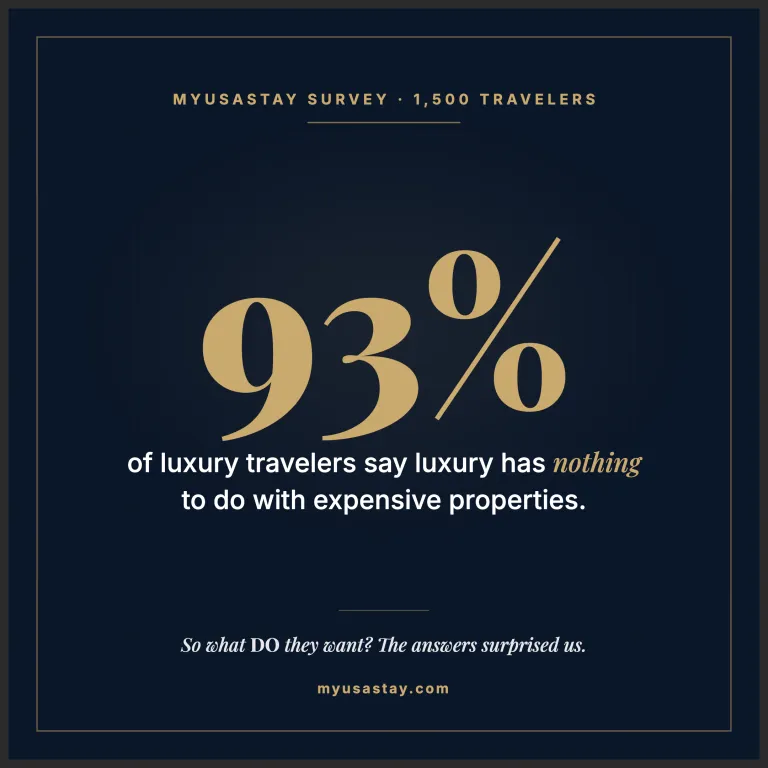
This is not a rejection of luxury hotels. It is a redefinition of what premium accommodation means. Nearly 70% of respondents agreed with the statement that "modern luxury hotels have lost their soul." They used words like "formulaic," "performative" and "Instagram-optimized" to describe recent stays at destinations they previously considered exceptional. Ninety-three percent of luxury travelers told us that true quality is about access to authentic experiences, not brand exclusivity.
The private accommodation market is responding. HomeExchange reported more than 270,000 members across 155 countries in 2025, with 43% year-over-year growth and 3.5 million nights exchanged. Hamptons peak summer rental rates climbed up to 30% year-over-year, with median sales prices reaching a record 2.34 million dollars in Q4 2025. Inquiry data for 2026 points to strong growth in secluded estates with staff, wellness facilities and enhanced security.
Hotels that are thriving have shifted toward what the industry calls a high-touch, elevated travel model. Think resort buyouts where chefs, guides and other experts are available on demand. The Virtuoso Luxe Report dubs this "Unlimited Luxe," noting that "all-inclusive" has been elevated beyond the term's traditional associations. The concept now covers private transfers, Michelin-level dining programs, personalized wellness protocols and dedicated cultural guides. Seventy percent of loyalty program members consider out-of-property benefits important, with nearly a quarter calling them "very important."
Finding 4: The Generational Handover Is Already Here
We deliberately oversampled respondents aged 28-42 because our preliminary data suggested this cohort was driving a disproportionate share of premium spending. The results confirmed it.
Millennial respondents in our survey spent 22% more per trip than Baby Boomers, contradicting the persistent assumption that younger travelers trade down on accommodation quality. What they spend differently on is the revealing part. Millennials allocated 34% more budget toward luxury experiences (cooking classes, guided cultural walks, craft workshops) and 18% less toward room upgrades (suite categories, club-level access, premium floors).
American Express data supports this global travel trend. Their 2026 report on global consumer behavior, based on 7,000 respondents across seven countries, found that 74% of Millennials and Gen Z consider vacations a "non-negotiable" expense. Seventy-nine percent seek workshops and activities specific to where they are. Eighty-three percent prioritize authentic experiences over popular attractions. Eighty-two percent say learning new skills creates their most memorable moments.
The technology gap is real but nuanced. Forty-three percent of high-income Millennials use generative AI in planning, compared to 25% overall (up from 15% in 2025). Gen Z uses short-form social media video as a primary research tool, and their influence extends far beyond their own reservations. But both generations still rely heavily on travel advisors for complex itineraries. Ninety-six percent of ultra-wealthy respondents use professional advisors, regardless of age.
Sustainability matters more to younger travelers but not in the way the industry has marketed it. Thirty-eight percent of Millennials and 42% of Gen Z consider environmental impact when planning. Yet when we pressed our respondents on what "sustainable" meant to them, the answers were pragmatic rather than ideological: regionally sourced food, reduced plastic, supporting community businesses. Forty percent said they would pay a 30-50% premium for genuinely eco-friendly accommodations. Eighty-five percent prefer brands that align with their values, according to McKinsey.
Finding 5: Destinations Are Chosen for Stories, Not Scenery
We showed respondents twelve destination photographs without labels and asked them to rank appeal. Then we showed the same destinations with contextual stories (a vineyard in Tuscany where the family has made wine for nine generations, a ryokan in Kyoto maintained by the same lineage for 300 years). Rankings shifted dramatically. Destinations with compelling narratives moved up an average of 3.2 positions.
This aligns with what American Express calls "lore chasing." Eighty-seven percent of respondents in their 2026 study on consumer behavior leave itinerary room for unexpected discoveries. Seventy-six percent are likely to attempt adventurous activities outside their comfort zones. The desire is not just for beauty but for a story worth telling. Film and television are now strong catalysts too. The Virtuoso Luxe Report identifies "Main Character Synergy" as a defining travel trend, where respondents seek destinations they have seen on screen.
Japan leads international destination rankings for the third consecutive year among our respondents, followed by Italy, Greece, Iceland and France. Domestically, Hawaii tops the list, followed by Montana, the California coast, New England in autumn and the Colorado Rockies. The Amalfi Coast and Paris remain perennial favorites, but emerging destinations like Greenland, the Caribbean coast of Colombia and Portugal's Alentejo region showed the strongest year-over-year interest growth. Dubai, Singapore and several Middle East destinations are also rising fast, particularly among younger travelers influenced by social media.
Climate change is reshaping these choices in measurable ways. Forty-five percent of Virtuoso advisors report clients adjusting plans due to climate shifts, with 76% of affected clients choosing shoulder-season or off-peak travel windows and 75% favoring moderate-weather locations. The Luxe Report frames this as "Crowd Control," noting that comfortable climates and freedom from overtourism are themselves a form of luxury. Summer is stretching: post-Labor Day departures grew from 12% of summer volume in 2022 to 20% in 2026. Shoulder season bookings have increased 13% on average.
Finding 6: The Cruise Comeback Nobody Predicted
Cruising was the sleeper hit of our survey. Among the wealthiest 1% of travelers, interest jumped from 37% in 2019 to 53% in 2025. Our respondents who expressed interest specifically mentioned expedition-style itineraries (Antarctica, the Norwegian fjords, Galapagos, Iceland), not the mega-ship Caribbean circuits most people picture.
The luxury cruise segment is being reshaped by boutique operators offering 100-passenger vessels with onboard naturalists, Michelin-trained chefs and zodiac excursion programs. Several respondents cited the revival of the Orient Express brand as a catalyst for renewed interest in elevated travel by sea and rail. Forty-five percent of Amex respondents said luxury rail travel was their top unconventional accommodation interest, followed by converted historical spaces (37%). Ninety-one percent of Millennials and Gen Z expressed interest in at least one non-traditional lodging type.
Multi-generational travel is driving much of this cruise demand. Sixty-six percent of respondents in the American Express Global Travel Trends study plan milestone celebration getaways in 2026, with 82% building in buffer days around the main event. Cruise itineraries, which handle logistics for groups of varying ages and mobility levels, have become the path of least resistance for family reunions and anniversary celebrations. Respondents who planned to travel longer on these milestone vacations cited quality family time (49%) and exploring new places (45%) as their primary motivations.
Finding 7: Food Has Become the Primary Travel Motivator (Not a Side Benefit)
When we analyzed the open-text responses where respondents described their most memorable 2025 trip moment, 38% referenced a food experience as the highlight. Not a meal at a famous restaurant, necessarily, but a specific culinary encounter: learning to make pasta from a grandmother in Puglia, eating freshly caught ceviche on a Peruvian fishing boat, discovering a hole-in-the-wall ramen shop in Tokyo through a neighborhood recommendation.
American Express calls this "snackpacking." Eighty-nine percent of Millennials and Gen Z prioritize local snacks when building itineraries. Sixty percent of respondents often or always purchase destination-specific foods. Sixty-six percent seek items unavailable at home. Seventy-five percent of younger travelers actively hunt for viral food items during their trips. Fifty-four percent of U.S. respondents are building entire vacations around concerts, festivals or performing arts, suggesting that experiential anchors of all kinds are replacing traditional sightseeing as the organizing principle of a trip.
The culinary segment of luxury travel is growing at a compound annual growth rate of 9.8% through 2033, the fastest of any category in the premium segment. Safari and adventure holds the largest market share at 33.3%, but culinary tourism is closing fast. Our respondents who ranked food as their primary travel motivator spent 28% more on their trips overall than those who ranked it lower, suggesting that food-driven respondents are also the highest-value segment.
What This Means for the Future of Luxury Travel
After reviewing all 1,500 responses and cross-referencing against 17 industry trends reports, we see a single thread connecting every finding: the luxury traveler of 2026 defines quality through personal meaning, not price tags. The 12,400-dollar-per-trip spenders are not buying opulence for its own sake. They are buying time, wellness, authenticity, privacy and stories.
The implications are significant. Hotels that compete on thread count and lobby design will keep losing ground to those offering high-touch, personalized programming. Destinations that market only scenery will lose to those marketing narrative and cultural depth. Travel advisors who focus on logistics will be displaced by those who function as lifestyle curators. And the brands that understand this generational handover, that Millennials and Gen Z now drive more premium spending than their parents, will capture the next decade of growth.
The urgency is real. The Virtuoso Luxe Report identifies a "From FOMO to Slow-mo" travel trend, where luxury travelers feel compelled to explore extraordinary adventures (tracking Kenya's Great Migration, glacier hikes in Iceland, coral reef encounters in the Pacific) because global environmental changes mean "someday" genuinely cannot wait. That sense of now-or-never is reshaping destination choices, schedules and how much travelers are willing to spend. It also defines what the modern market cannot afford to misunderstand.
Key Statistics From Our Survey of Affluent Travelers
- 1.77 trillion dollars: estimated global premium market size in 2025, heading toward 2.1 trillion by 2030
- 12,400 dollars: average spend per trip among the top 1% of U.S. households (up 48% from 8,400 in 2022)
- 71%: share of respondents citing personal renewal as an important travel motivation (Virtuoso)
- 54%: respondents choosing private villas over branded suites
- 34%: wealthiest 1% of travelers planning a wellness trip (up from 23%)
- 43%: high-income Millennials using generative AI for trip planning (Deloitte)
- 38%: Gen Z travelers planning luxury stays in 2026 (Deloitte)
- 35%: projected increase in itineraries exceeding 50,000 dollars for the 2026-2027 season (Virtuoso)
- 53%: wealthiest 1% of travelers interested in cruising (up from 37% in 2019)
- 45%: Virtuoso advisors reporting increased ultraluxe requests
- 93%: respondents saying quality is about authentic experiences, not hotel exclusivity
- 9.8%: CAGR of culinary tourism through 2033, the fastest-growing segment
- 70%: respondents who feel modern luxury hotels have "lost their soul"
- 40%: willing to pay 30-50% more for genuinely sustainable accommodations
FAQ: Survey of Affluent Travelers 2026
What do luxury travelers prioritize most in 2026?
Personal renewal and wellness topped the list, followed by cultural immersion and family connection. Exclusive VIP access, long considered the hallmark of luxury travel, dropped to seventh place in our ranking exercise. This reflects a broader travel trend: 71% of Virtuoso-surveyed travel advisors cite personal renewal as a primary client motivation, and 34% of the wealthiest 1% are specifically planning wellness trips.
How much do luxury travelers spend per trip in 2026?
The wealthiest 1% of U.S. households average 12,400 dollars per luxury trip, up from 8,400 in 2022. The top 10% average 7,900 per trip, compared to 3,700 for the typical American traveler. High-income Millennials budget 1.6 times more for their marquee trips than other demographic groups, and Virtuoso projects luxury travel itineraries exceeding 50,000 dollars will rise 35% for the 2026-2027 season.
Are younger travelers really driving luxury travel growth?
Overwhelmingly yes. Millennials and Gen Z now account for half of all travelers according to Deloitte, with Gen Z nearly doubling from 8% in 2024 to 14% in 2025. In our survey, Millennial luxury travelers spent 22% more per trip than Baby Boomers, allocating disproportionately toward experiences rather than accommodation upgrades. Over 80% of high-income Millennials plan to travel in 2026.
What destinations are luxury travelers choosing in 2026?
Japan leads international destination rankings for the third consecutive year, followed by Italy, Greece, Iceland and France. The Amalfi Coast and Paris remain evergreen destinations, but emerging locations showing the strongest growth include Greenland, Portugal's Alentejo region and the Caribbean coast of Colombia. Domestically in the U.S., Hawaii, Montana and the California coast top the list. Climate adaptation is reshaping choices: 76% of climate-aware travelers now choose shoulder-season or off-peak timing, and post-Labor Day volume has grown from 12% to 20% of summer departures since 2022.