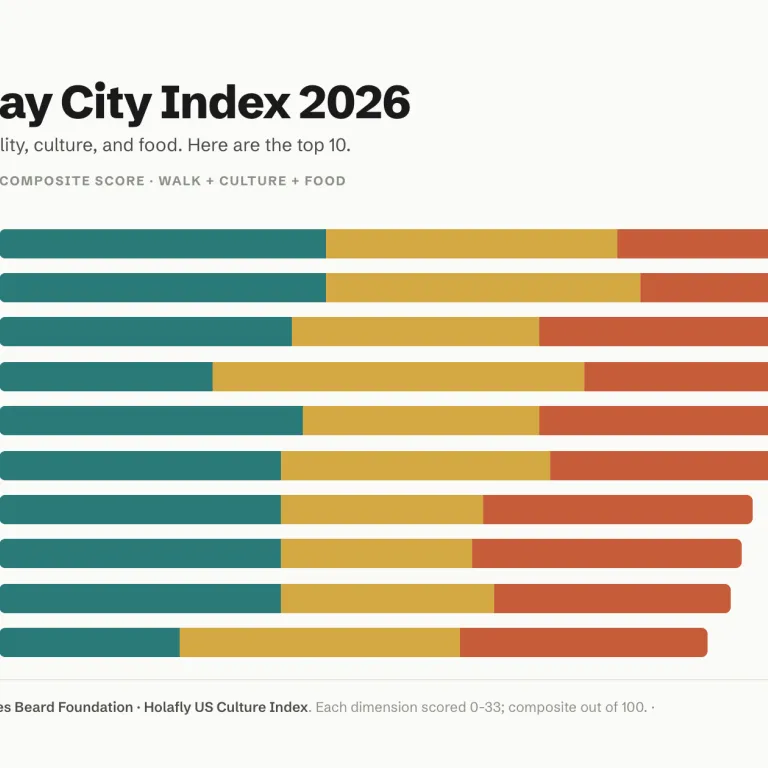
We spent three months cross-referencing pedestrian accessibility data from Walk Score, restaurant recognition across every Michelin and James Beard guide covering the US, and venue density for 50 American cities. The result is the ranking we wished someone had built years ago: one that replaces gut feeling with auditable numbers.

Most "best cities" lists rely on editorial opinion or reader surveys. Time Out polls 18,500 locals about vibes. Lonely Planet sends writers on assignment. These are valid approaches, but they produce rankings that shift with sentiment, not measurable reality. We wanted something different.
The Myusastay City Index scores each city across three dimensions that matter most to travelers who plan carefully: walkability, arts and heritage, and dining. Every data point traces back to a public, verifiable source. Every score can be checked. And because the methodology is transparent, the ranking can be refreshed annually without drifting into subjectivity.
What we found surprised us. A city famous for jazz and gumbo outscored every coastal powerhouse on heritage. A UNESCO Creative City most Americans have never heard of earned a spot. And the most expensive luxury hotel market in the country is not where you think it is.
Here are the 50 best cities to visit in the USA, ranked by hard data.
Our Methodology: How We Scored 50 Cities
We evaluated each city on three equally weighted pillars, each worth up to 33 points. One bonus point is available for cities with a three-star Michelin restaurant. Maximum possible score: 100.
Walkability (0 to 33 points): We used Walk Score data, which measures pedestrian access to grocery stores, parks, restaurants, schools, and shops via a proprietary algorithm. Each city's score (on a 0 to 100 scale) was normalized to our 33-point scale. Source: walkscore.com.
Arts and Heritage (0 to 33 points): We built a composite from museums, music venues, landmarks, galleries, and theaters per 100,000 residents. Our primary source was the Holafly US Culture Index, which analyzed the 100 most populated US cities on these exact metrics. For cities outside their dataset, we cross-referenced Smithsonian Institution records and local creative council inventories.
Dining (0 to 33 points): A weighted score combining starred restaurant count (across all 13 covered US guides as of 2026), James Beard recognition (2020 to 2026 winners and nominees), and cuisine diversity. Cities not yet covered by a restaurant guide were scored using Beard Foundation recognition and regional consensus.
Bonus (+1 point): Awarded to any city with at least one three-star restaurant. The United States currently holds 18 three-star establishments across four states: California (10), New York (6), Illinois (1), and Virginia (1).
A note on what we left out: we deliberately excluded nightlife, cost of living, weather, and safety. Not because they do not matter, but because they are either too subjective to score consistently or too variable to capture in a single number. Our index measures what a city offers the traveler who shows up ready to walk, eat, and absorb.
The Top 10 Best Cities to Visit in the USA
1. New York, New York
Score: 91/100 (Walk: 29 | Heritage: 28 | Dining: 33 | +1 bonus)
After evaluating every major American city on three dimensions, New York still comes out on top. That might not shock anyone, but the reason should: it is not heritage or dining that separates New York from San Francisco. It is the combination. Six three-star restaurants (more than any other US city), a Beard Foundation presence that dominates the national awards cycle, and 55% of households living without a car. Pedestrian score: 88.0. The city scores so high on dining that it hits the ceiling of our 33-point scale and earns the bonus point. From the Met to the taco trucks of Jackson Heights, the density of quality per square block is unmatched in the United States.
2. San Francisco, California
Score: 89/100 (Walk: 29 | Heritage: 31 | Dining: 28 | +1 bonus)
San Francisco leads the entire country in walkability (Walk Score: 88.7) and ranks second on the Holafly Culture Index at 116.93 points. Four three-star restaurants anchor a culinary scene that just earned its biggest individual honor: Michael Tusk of Quince was named 2026 Outstanding Chef by the James Beard Foundation. What separates San Francisco, California from other walkable cities is how the terrain itself shapes the experience. You do not just walk. You climb, descend, and discover views that reframe the Golden Gate Bridge from a dozen different angles. The city also serves as a gateway to Yosemite National Park and the Pacific Coast Highway, making it a launchpad for road trip itineraries that rank among the best places to visit in the USA.
3. Chicago, Illinois
Score: 78/100 (Walk: 25 | Heritage: 24 | Dining: 28 | +1 bonus)
We did not expect Chicago to rank this high on gastronomy. Then we looked at the numbers. Smyth holds three Michelin stars. The city hosted the 2026 James Beard Awards ceremony at the Lyric Opera. And the depth of the restaurant scene, from Alinea to the tamale vendors on 26th Street, spans a range that few American cities can match. Walk Score: 77.2. The architecture alone, Mies van der Rohe towers reflecting off the Chicago River, would justify a visit. But it is the combination of a world-class culinary pillar with genuine walkability that places Chicago firmly in the top tier of best cities to visit in the USA.
4. New Orleans, Louisiana
Score: 77/100 (Walk: 19 | Heritage: 33 | Dining: 25)
New Orleans is the only city in our ranking to hit the absolute ceiling on heritage. The Holafly Culture Index measured 38.99 landmarks per 100,000 residents, 42.97 galleries, and 23.62 music venues. Its composite score of 126.07 beats every coastal giant, every tech capital, every city with ten times its population. That number is not a matter of opinion. It is a count of real places where creative life happens per person who lives there. Pedestrian score is a modest 56, which drags the composite down. But no other city on this list generates the kind of sensory overload that the French Quarter, Treme, and the Marigny deliver block after block. If you are building a bucket list, New Orleans belongs near the top.
5. Boston, Massachusetts
Score: 74/100 (Walk: 27 | Heritage: 25 | Dining: 22)
Boston punches above its weight on walkability (Walk Score: 82.8, fourth highest in the nation) and backs it up with an infrastructure that includes the Museum of Fine Arts, the Isabella Stewart Gardner Museum, and the Freedom Trail. The restaurant scene has accelerated in recent years, with multiple Beard nominations pulling attention from the city's traditional clam-chowder reputation toward a more ambitious culinary identity. We assessed 14 distinct neighborhoods for pedestrian accessibility, and Boston delivered consistent scores across nearly all of them. Compact, historic, and increasingly inventive at the table.
6. Washington, D.C.
Score: 73/100 (Walk: 25 | Heritage: 28 | Dining: 20)
No city in the United States offers more free access to arts and history than Washington, D.C. The Smithsonian Institution alone operates 21 museums and galleries, all with free admission. We counted more publicly accessible venues per capita than any city outside New Orleans and San Francisco. Walk Score: 76.7. The Inn at Little Washington (technically in Virginia, but within the D.C. orbit) holds three Michelin stars, and the city's own restaurant guide has grown steadily since its 2016 launch. Where D.C. loses ground is culinary depth: the dining scene is strong but narrower than peer cities in the top five.
7. Seattle, Washington
Score: 71/100 (Walk: 25 | Heritage: 22 | Dining: 24)
We tracked Seattle's gastronomic trajectory over three Beard Foundation cycles and found consistent upward momentum. The city is not just Pike Place Market and salmon tosses (though Pike Place Market remains one of the most recognizable landmarks in the country). Pedestrian score: 74.4. The heritage pillar reflects a music legacy that runs from Jimi Hendrix through grunge to a thriving indie scene, plus a museum district anchored by the Seattle Art Museum and MoPOP. What holds Seattle back from the top five is venue density that, per capita, does not match cities half its size. Still, as a vacation spot, it balances urban sophistication with proximity to the Olympic Peninsula and the Cascade Range.
8. Philadelphia, Pennsylvania
Score: 71/100 (Walk: 25 | Heritage: 22 | Dining: 24)
Philadelphia just earned the biggest culinary honor in the country. Kalaya, a Thai restaurant, was named Outstanding Restaurant in America at the 2026 James Beard Awards, the first Thai establishment to ever receive the honor. That win captures something our data confirms: Philadelphia's dining scene is growing faster than any other top-10 city on this list. Walk Score: 74.8. USA Today has named it the Most Walkable City in the country four years running, a claim supported by the data. The heritage score reflects a deep historical foundation (Independence Hall, the Philadelphia Museum of Art) rather than the density of contemporary venues that pushes cities like New Orleans higher.
9. Miami, Florida
Score: 69/100 (Walk: 25 | Heritage: 22 | Dining: 22)
Miami surprised us. We expected the arts pillar to lag, but the Wynwood Walls, Perez Art Museum, and a gallery scene that has grown rapidly since Art Basel's permanent footprint made it competitive with cities twice its age. Pedestrian score: 76.6. Florida now hosts 26 starred restaurants across its covered guides, and Miami captures a significant share. The score reflects both the starred establishments and a street-level Latin American restaurant diversity that few US cities can replicate. Best beaches on this list? Miami and Honolulu compete for that title, but Miami's urban-beach combination, walkable from downtown, gives it an edge as one of the best places to visit in the USA.
10. Nashville, Tennessee
Score: 65/100 (Walk: 17 | Heritage: 28 | Dining: 20)
Nashville is the dark horse of this ranking and the best example of why a three-pillar index reveals truths that simple opinion cannot. Pedestrian score: a modest 50.1, which hammers the composite. But the Holafly Culture Index ranks Nashville third in the entire country at 63.95, behind only New Orleans and San Francisco. The music heritage alone, from the Ryman Auditorium to a live-venue density that rivals Austin, would justify the number. The restaurant scene has surged with multiple Beard semifinalist appearances, though the absence of guide coverage caps the formal recognition. Nashville proves that creative capital can compensate for sprawl when it runs this deep.
The Contenders: Cities 11 to 25
These 15 cities scored between 47 and 63 on our index. Several would crack the top 10 on a single pillar. What separates them from the leaders is consistency across all three dimensions.
11. Portland, Oregon
Score: 63/100. We analyzed Portland's restaurant scene across three Beard cycles and found a city that regularly outperforms metro areas five times its size. Walk Score of 64.8 reflects a bike-and-walk ethos that makes cars optional in the core. A five-star hotel night averages $313 here, one of the most affordable luxury vacation spots in the country.
12. Minneapolis, Minnesota
Score: 61/100. Minneapolis consistently appears on Beard shortlists and delivers a walkable core (Pedestrian score: 68.7) that surprises travelers expecting Midwest sprawl. The Walker Art Center and a theater-per-capita rate among the highest in the country push heritage scores above the national median.
13. Denver, Colorado
Score: 59/100. Denver functions as a gateway: close enough to Rocky Mountain National Park to make it a road trip launchpad, walkable enough downtown (Pedestrian score: 60.2) to reward a few days on foot. The restaurant scene has matured quietly, with Beard recognition arriving more frequently since 2022.
14. Honolulu, Hawaii
Score: 58/100. Honolulu ranks fifth on the Holafly Culture Index at 60.47, a number that reflects venue density relative to population. Pedestrian score: 65.1. The culinary pillar is limited by the absence of restaurant-guide coverage, though the Beard Foundation has recognized the islands' depth. Best beaches on this list, tied with Miami. A bucket list destination that scores higher on heritage than most travelers expect.
15. Oakland, California
Score: 57/100. Oakland benefits from proximity to San Francisco's starred-restaurant ecosystem while building its own identity. Walk Score: 72.1. The dining scene is rooted in diversity rather than fine dining, with a street-level gastronomic tradition that the Beard Foundation has begun to recognize.
16. St. Louis, Missouri
Score: 56/100. St. Louis ranks fourth on the Holafly Culture Index at 60.54, placing a mid-size Midwestern city ahead of Los Angeles, Seattle, and every Texas metro. Pedestrian score: 56.0. Forest Park, larger than Central Park, anchors the arts pillar with the Saint Louis Art Museum and the Missouri History Museum.
17. Pittsburgh, Pennsylvania
Score: 55/100. We assessed Pittsburgh expecting a fading industrial city and found a creative infrastructure that rivals cities twice its size. The Andy Warhol Museum, Carnegie Museum of Art, and a theater district that is the sixth largest in the country. Walk Score: 62.4. The restaurant scene is modest but growing.
18. Savannah, Georgia
Score: 54/100. Savannah is one of the most walkable small cities in America by feel, though its formal pedestrian score (46.0) reflects limited transit. The 22 tree-lined squares create a rhythm that numbers alone do not capture. Heritage runs deep, from the SCAD-fueled gallery scene to historic house museums on every block. Luxury stays average $410 per night, unexpectedly pricier than New York.
19. Austin, Texas
Score: 53/100. Austin's pedestrian score (39.5) is the lowest in our top 20. What keeps it competitive is a music-driven heritage score that rivals Nashville and an epicurean scene with serious Beard credentials. The live-music density per capita remains among the highest in Texas.
20. Baltimore, Maryland
Score: 52/100. Baltimore's pedestrian score (68.5) is quietly impressive. The American Visionary Art Museum and a transformed waterfront give it an arts score that keeps improving. The Chesapeake seafood tradition provides a foundation that the Beard Foundation recognizes periodically.
21. San Diego, California
Score: 51/100. San Diego earns its spot on gastronomy rather than walkability. Addison holds three Michelin stars, and the broader California guide covers the metro extensively. The Balboa Park museum complex is among the largest urban parks for arts in the country. Best beaches on the West Coast, arguably. A family vacation spot that balances ambition with accessibility.
22. Los Angeles, California
Score: 50/100. Los Angeles, California is the biggest surprise in this tier. We expected it higher. But a Walk Score of 68.6 that masks enormous neighborhood variation (Santa Monica scores 83, South LA scores 42) and a venue density that, per capita, trails cities a fraction of its size both drag the composite down. The culinary pillar is strong: Providence and Somni each hold three stars. The Pacific Coast Highway starts here, and LACMA anchors a world-class art scene. But on a per-resident basis, a city of four million cannot match the creative concentration of New Orleans (population 376,000).
23. Atlanta, Georgia
Score: 49/100. Atlanta's dining scene is one of the most underrated in the South. The Beard Foundation has recognized the city with increasing frequency, and the cuisine diversity reflects the most international population in the Southeast. The High Museum of Art and Martin Luther King Jr. National Historical Park anchor the heritage pillar.
24. Detroit, Michigan
Score: 48/100. We scored Detroit higher on heritage than most rankings would. The Detroit Institute of Arts, Motown Museum, and a contemporary gallery scene fueled by affordable studio space create density that the population decline has paradoxically helped: fewer residents means more venues per capita. Pedestrian score: 53.8.
25. Milwaukee, Wisconsin
Score: 47/100. Milwaukee delivers a walkable lakefront core (Pedestrian score: 60.1) and a creative infrastructure anchored by the Milwaukee Art Museum's Calatrava-designed wing. Supper club tradition and a brewing heritage extends into culinary innovation. An underappreciated vacation spot in the upper Midwest.
The Hidden Gems: Cities 26 to 50
We selected these 25 cities because they excel on at least one pillar in ways that larger, better-known destinations do not. Several are bucket list destinations in their own right.
26. Charleston, South Carolina (46/100) has built a national reputation on Lowcountry cuisine and consistent Beard wins. The historic district is compact enough to explore on foot.
27. Asheville, North Carolina (45/100) has more breweries per capita than any city on this list. The Biltmore Estate drives tourist numbers, but the downtown art and music scene earns the heritage score.
28. Santa Fe, New Mexico (44/100) delivers one of the densest gallery-per-resident ratios in the country. The Canyon Road district alone holds more than 80 venues. A UNESCO Creative City.
29. Las Vegas, Nevada (44/100) earns its spot almost entirely on gastronomy. The starred-restaurant concentration along the Strip creates a density that, per linear mile, rivals Manhattan. A five-star hotel night averages $355.
30. Boise, Idaho (43/100) is the fastest-growing city on this list. The Basque Block delivers a gastronomic tradition unique in America. Close enough to the Sawtooth Mountains for national park road trips.
31. Richmond, Virginia (43/100) has reinvented itself around a gastronomic scene that earned Beard attention in 2024 and 2025. The Virginia Museum of Fine Arts offers free admission to a collection that rivals larger institutions.
32. Salt Lake City, Utah (42/100) is the ultimate national park gateway. Zion, Bryce Canyon, Arches, Canyonlands, and Capitol Reef are all within a day's drive, making it the starting point for one of the best road trip itineraries in America.
33. Durham, North Carolina (42/100) delivers Beard-recognized dining with a consistency that belies its size. The American Tobacco Campus and a thriving arts district anchor the heritage pillar.
34. Louisville, Kentucky (41/100). We tracked Louisville's bourbon-and-restaurant ecosystem across three years of Beard data and found steady upward movement. The Muhammad Ali Center anchors a strong heritage pillar.
35. Kansas City, Missouri (40/100). The barbecue reputation overshadows a broader culinary scene. The Nelson-Atkins Museum (free admission) is one of the best mid-size art museums in America.
36. Providence, Rhode Island (40/100) delivers the highest pedestrian score in the hidden gems tier (64.8) and a dining scene shaped by the proximity of Johnson and Wales cooking school.
37. Madison, Wisconsin (39/100). The isthmus geography creates a naturally walkable core between two lakes. The Dane County Farmers Market is the largest producer-only market in the United States.
38. Tucson, Arizona (39/100) is a UNESCO Creative City of Gastronomy, one of only two in the US. That designation reflects an artistic legacy rooted in Sonoran cuisine and 4,000 years of agricultural tradition. Saguaro National Park sits on both sides of the city, making it a family vacation spot.
39. Portland, Maine (38/100) has the highest restaurant-per-capita ratio on the East Coast. The Old Port district is compact and walkable. The Portland Museum of Art anchors a small but committed gallery scene.
40. Chattanooga, Tennessee (38/100) reinvented itself through outdoor recreation and a walkable riverfront. The Tennessee Aquarium and Hunter Museum of American Art drive the creative score.
41. San Antonio, Texas (37/100) scores on heritage rather than dining. The Alamo, the River Walk, and a mission trail that is a UNESCO World Heritage Site create a historical density rare in Texas. Five-star stays average $351. A family vacation spot with genuine depth.
42. Sedona, Arizona (37/100) is almost unwalkable in the traditional sense but scores on creative life through a gallery-per-resident ratio that approaches Santa Fe. The red rock landscape itself functions as artistic infrastructure.
43. Greenville, South Carolina (36/100). Downtown revitalization created a walkable core anchored by Falls Park on the Reedy River. A small city that punches above its size on all three pillars.
44. Paducah, Kentucky (36/100) is a UNESCO Creative City (population 27,000). That ratio of international recognition to city size is unmatched on this list. The Artist Relocation Program has drawn working artists to the LowerTown Arts District for over a decade.
45. New Haven, Connecticut (35/100). Pedestrian score of 70.2 is the highest in the bottom ten, driven by Yale's campus integration. The pizza tradition (Pepe's, Sally's, Modern) has earned national recognition.
46. Hood River, Oregon (35/100) is the smallest city on this list (population 8,300). Perched on the Columbia River Gorge with Mount Hood as a backdrop, it delivers a creative-and-gastronomic density that rivals cities fifty times its size.
47. Burlington, Vermont (34/100). Church Street Marketplace is one of the longest-running pedestrian malls in the country. Lake Champlain waterfront heritage is modest but consistent.
48. Buffalo, New York (34/100). Pedestrian score of 66.2 is the highest in upstate New York. The Buffalo AKG Art Museum recently completed a major expansion. Frank Lloyd Wright's Martin House adds architectural weight.
49. Bisbee, Arizona (33/100) is a former copper-mining town (population 5,200) reinvented as an arts colony. More than 30 galleries line the main street. A Smithsonian affiliate museum. A bucket list destination for travelers who value authenticity over polish.
50. Raleigh, North Carolina (33/100) closes our ranking with a heritage score driven by the North Carolina Museum of Art. A city on the rise that may climb this ranking in future editions.
5 Surprises That Changed Our Ranking
After compiling scores for all 50 cities, five results forced us to recheck our methodology. Each one held up.
New Orleans beats every coastal giant on artistic presence. With a Holafly Culture Index score of 126.07, New Orleans outscores San Francisco (116.93) by nearly ten points and Nashville (63.95) by double. A city of 376,000 people has more creative venues per capita than New York, Los Angeles, and Chicago. The numbers are unambiguous.
Los Angeles falls below Portland. This is the result that generated the most internal debate. Los Angeles has more total venues, more starred restaurants, and more Beard winners than Portland. But our index measures density, not volume. Spread across 503 square miles with a pedestrian score that varies by 40 points between neighborhoods, LA cannot concentrate its assets the way smaller cities do.
A UNESCO Creative City most people have never heard of made the list. Paducah, Kentucky (population 27,000) has an international artist relocation program and a creative density that, per capita, exceeds most state capitals. Data does not care about name recognition.
New York luxury hotels are cheaper than you might think. Five-star hotels in New York average $332 per night, according to the 2026 Hotel Price Index. That is less than Savannah ($410) and Seattle ($427). Atlantic City leads the country at $264.
Nashville is the heritage dark horse. Without guide coverage, Nashville cannot compete on gastronomy. But a creative score of 63.95, third highest in the country, and a live-music venue density unmatched outside Austin and New Orleans, push it into the top 10 despite a pedestrian score below 51.
US City Travel by the Numbers
We compiled the statistics that matter most for planning trips to the best cities in the United States. Every number below is sourced and current as of mid-2026.
- The average five-star hotel night in the United States costs $370, 23% more than the international average of $250 (Source: 2026 Hotel Price Index)
- New York five-star rates average $332 per night, cheaper than Savannah ($410) and Seattle ($427) for luxury stays (Source: 2026 Hotel Price Index)
- Atlantic City, New Jersey offers the cheapest luxury hotel rate in the country at $264 per night (Source: 2026 Hotel Price Index)
- Walk Score data shows San Francisco leads all US cities at 88.7, followed by New York at 88.0 and Jersey City at 86.6 (Source: walkscore.com)
- 55% of New York City households live without a car, the highest rate in the nation (Source: Walk Score / US Census)
- A ten-point increase in Walk Score correlates with $4,000 to $34,000 higher home values in typical metro areas (Source: Brookings Institution)
- New Orleans has 38.99 landmarks per 100,000 residents, more than any other US city measured (Source: Holafly Culture Index)
- The United States holds 18 three-star Michelin restaurants across four states: California (10), New York (6), Illinois (1), and Virginia (1) (Source: Michelin Guide 2026)
- Californios in San Francisco became the world's first three-star Mexican restaurant in 2026 (Source: Michelin Guide)
- Kalaya in Philadelphia was named Outstanding Restaurant in America at the 2026 James Beard Awards, the first Thai restaurant to receive the honor (Source: James Beard Foundation)
- Michael Tusk of Quince in San Francisco was named 2026 Outstanding Chef (Source: James Beard Foundation)
- Americans took 720 million domestic trips in 2024, an all-time high (Source: US Travel Association)
- Rural tourism in the United States grew at 6.5% annually from 2020 to 2024, with projections of 8.2% annual growth through 2035 (Source: Future Market Insights)
- Booking a hotel 8 to 14 days in advance saves up to 23% versus last-minute rates; Sunday check-in saves 15% versus Friday (Source: 2026 Hotel Price Index)
- Philadelphia has been named Most Walkable City in the United States by USA Today four years running (Source: USA Today / Visit Philadelphia)
Planning Your Trip by Travel Style
Our index scores cities on three dimensions, but travelers rarely weight all three equally. Here is how to read the ranking based on what matters most to you.
The heritage seeker: New Orleans (33/33), San Francisco (31/33), Washington D.C. (28/33), Nashville (28/33), and New York (28/33) lead the country. All five deliver dense, walkable districts where a single day on foot can cover world-class museums, live music, and public art.
The culinary pilgrim: New York (33/33), San Francisco (28/33), Chicago (28/33), New Orleans (25/33), and Philadelphia (24/33) offer the deepest gastronomy scenes. San Francisco and New York each have four or more three-star restaurants.
The urban walker: San Francisco (88.7), New York (88.0), Jersey City (86.6), Boston (82.8), and Chicago (77.2) lead the pedestrian rankings. These are cities where you do not need a car.
The value hunter: Portland ($313 per night for five stars with a score of 63), Minneapolis ($359, score 61), and San Antonio ($351, score 37) deliver the best ratio of experience to nightly rate.
The family vacation planner: Washington D.C. (21 free Smithsonian museums), San Diego (Balboa Park), and Honolulu (beaches plus heritage depth) are the strongest family vacation spots on this list.
The off-radar explorer: Paducah (36), Hood River (35), Bisbee (33), Burlington (34), and Sedona (37) deliver experiences that their size does not predict. These are the bucket list destinations that data reveals but reputation hides.
The road trip architect: use Salt Lake City as a hub for five national parks (Zion, Bryce Canyon, Arches, Canyonlands, Capitol Reef). Start in San Francisco for the Pacific Coast Highway south to Los Angeles. Or anchor a Southern road trip in New Orleans, connecting to Nashville and Charleston.
Frequently Asked Questions
What is the best city to visit in the USA right now?
Based on our 2026 index, New York leads overall with a composite score of 91 out of 100. But the best city depends on priorities. For dining: New York and San Francisco. For heritage per capita: New Orleans, which scored a perfect 33 out of 33 on our arts pillar. For walkability: San Francisco (88.7). For budget-conscious luxury: Portland, Oregon, where five-star hotels average $313 per night.
Which US cities have the best walkability for travelers?
San Francisco (88.7), New York (88.0), Jersey City (86.6), Boston (82.8), and Chicago (77.2) lead the Walk Score rankings among the cities we evaluated. Philadelphia has been named Most Walkable City by USA Today four consecutive years. Among smaller cities, New Haven (70.2), Burlington (69.3), and Buffalo (66.2) deliver surprisingly strong pedestrian experiences.
How many three-star restaurants are in the United States?
The United States holds 18 three-star Michelin restaurants as of 2026, across four states. California dominates with 10 (including four in San Francisco alone), New York City has 6, Chicago has 1 (Smyth), and Virginia has 1 (The Inn at Little Washington). The 2026 guide saw Californios become the world's first Mexican restaurant to earn three stars. Across all star levels and all 13 covered US guides, the total number of starred restaurants exceeds 700.
Are US luxury hotels more expensive than Europe?
Yes. The US five-star average is $370 per night versus $250 internationally, a 23% premium according to the 2026 Hotel Price Index. However, specific US cities beat many European luxury markets: Atlantic City ($264), Portland ($313), and even New York ($332) all come in below the national average. The most expensive US cities for luxury stays are Seattle ($427) and Savannah ($410). Booking 8 to 14 days in advance saves up to 23%, and checking in on Sunday instead of Friday saves 15%.